CBD shot: mixing it right the first time
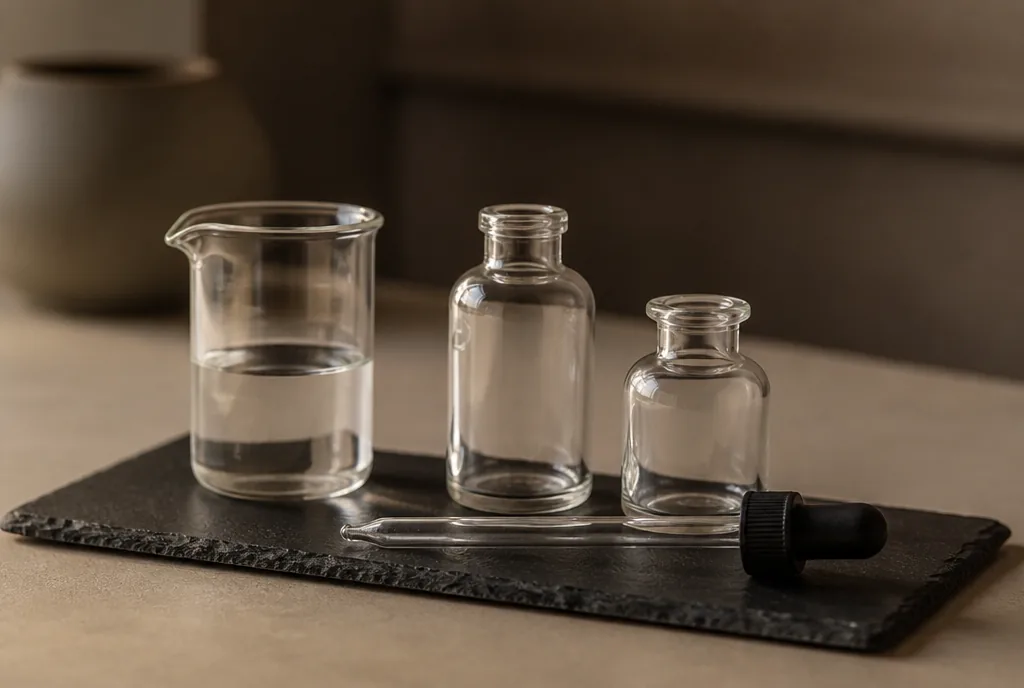
You have a small, heavily concentrated 10 ml bottle on one side, a nicotine free shortfill on the other, and no idea what proportion to respect. Pouring by eye gives you a blend that is either too thin to notice or so loaded that the vegetal note swamps the flavour. The whole thing rests on a single piece of arithmetic, and a CBD shot always behaves the same way whatever volume you are mixing.
The method: milligrams divided by the final volume
A CBD shot goes into a neutral base or a nicotine free e-liquid, never the other way round. Pour the shot into the larger bottle, close it, then turn it over repeatedly for about thirty seconds.
The resulting concentration is worked out like this: milligrams of cannabidiol contained in the shot, divided by the total volume of the mix in millilitres.
A 1,000 mg shot in 10 ml poured into 40 ml of e-liquid gives 50 ml in total, so 20 mg of cannabidiol per millilitre. The volume of the shot counts towards that total, and forgetting it is the single most common mistake.
What a CBD shot actually contains
Behind the word shot sits a simple product, but its composition drives everything else in the blend. Understanding its structure spares you unpleasant surprises at filling time.
It is a bottle of propylene glycol and vegetable glycerine base, loaded with cannabidiol and usually lightly flavoured or not flavoured at all. It is not designed to be vaped on its own.
British retailers stock these in 10 ml bottles as a rule, with stated strengths running from a few hundred milligrams up to several thousand per bottle. Larger 30 ml formats exist for people mixing bigger batches.
Why propylene glycol dominates the formula
Cannabidiol dissolves far better in propylene glycol than in vegetable glycerine. Manufacturers therefore tend to build their shots on a propylene glycol heavy base, sometimes pure PG.
The practical consequence is easy to miss. Adding a PG heavy shot to a very viscous base drags the final glycerine share of the blend downwards. Across a 50 ml bottle the shift stays modest, but it becomes noticeable on the draw of a sub ohm build, which is where the 70/30 ratio suddenly matters more than it did before mixing.
Working out how much CBD shot to use
The starting formula covers most situations, but the reverse operation is usually more useful: begin with the concentration you want and deduce how many bottles to open.
Multiply the target in mg/ml by the final volume you want, then divide by the amount of cannabidiol in one bottle. For 60 ml at 15 mg/ml you need 900 mg, so a 1,000 mg bottle leaves a small margin.
Rounding down rather than up is the safer habit. An over concentrated blend can only be corrected by adding volume, which means making more liquid than you planned and using more base than you intended.
On a 50 ml shortfill housed in a 60 ml bottle, a 1,000 mg shot brings the mix to roughly 16.6 mg/ml. The same bottle with a 2,000 mg shot climbs to nearly 33 mg/ml.
Those figures assume a bottle filled to the shoulder. When a shortfill holds 50 ml in a 60 ml bottle, the headroom corresponds exactly to a 10 ml shot, which is why that packaging became the British standard in the first place.
When a CBD shot disappoints
A dosage that is correct on paper can still give a poor result in practice. Three situations come up again and again, and all three are settled before you pour.
Cannabidiol brings a vegetal, faintly earthy note that layers over the flavour. It goes unnoticed on a woody or menthol profile, far less so on a light fruit blend. On a fruit e-liquid, aim for a moderate concentration and accept a more diluted mix rather than saturating the bottle.
A very concentrated shot can also take its time spreading through a thick base. A few hours resting at room temperature, bottle closed and shaken a second time, generally settles it.
Then there is the question of combining actives. Common practice keeps a CBD shot for nicotine free e-liquids. Stacking both in one bottle complicates the arithmetic and changes the result in the mouth with no identifiable technical benefit, which is a separate matter from mixing a nicotine salt shot into a shortfill.
Handling and storage, the part nobody writes down
Concentrated preparations deserve the same care as any other mixing ingredient. Wear gloves, work on a surface that wipes clean, and keep every bottle well out of reach of children and pets.
Store the shot and the finished blend upright, tightly capped, away from direct light and heat. Light is what degrades a preparation fastest, well before the printed date becomes relevant.
Label the finished bottle with the date, the strength of the shot used and the concentration you calculated. On a shelf holding three similar looking bottles, that label is the only thing that stops a second guess.
What the UK rules say about a CBD shot
The subject deserves stating plainly, because a great deal of approximation circulates. Two separate legal frameworks cross here and they do not have the same object.
Cannabidiol products sold in the United Kingdom are expected to be exempt products, which in practice means the container must hold no more than 1 mg of controlled cannabinoids, tetrahydrocannabinol among them. That threshold concerns the container, not the cannabidiol content, which is why a bottle can state several thousand milligrams of CBD and still sit inside the rules.
The ceilings vapers know best, 20 mg of nicotine per millilitre and 10 ml bottles, come from the Tobacco and Related Products Regulations 2016 and apply only to nicotine containing liquid. A CBD product carries no nicotine, so it is not bound by them, which explains the strengths printed in hundreds of milligrams. The same regulations cap tanks and cartridges at 2 ml, and sale to under-18s is prohibited.
No effect of any kind can be attributed to these products in an editorial piece. Cannabidiol is not a medicine and holds no recognised indication, so this guide sticks to arithmetic, mixing and hardware. If the sums are the part that puts you off, our step by step method for CBD dosage calculation walks through each operation.
Frequently asked questions
Can you vape a CBD shot neat?
That is not what it is for. The product is formulated to be diluted, and its high concentration combined with a large propylene glycol share gives a very dry result on most coils.
What hardware suits a cannabidiol e-liquid?
Low power, mouth to lung setups are the better fit because they run cooler. Coils above 1 ohm also limit the fouling that comes with loaded preparations.
How long does a CBD shot keep?
Like any propylene glycol and glycerine preparation, it keeps away from light and heat with the cap firmly closed. The best before date on the manufacturer’s label is the reference.
Why do some bottles show a percentage rather than milligrams?
The two notations convert directly: 1 percent equals 10 mg per millilitre. A 10 ml bottle stated at 10 percent therefore holds 1,000 mg.
Will I need to change coils more often?
Preparations rich in actives leave more residue on the cotton than a plain flavoured base. Rinsing the tank between refills stretches the interval between replacements.
CBD shot: the three reflexes that change everything
Remember the division of milligrams by total volume, the inclusion of the shot inside that volume, and the pouring order from the small bottle into the large one. Those three habits are enough to land on a predictable concentration every time.
The rest is personal adjustment: the strength of the CBD shot, the flavour profile of the base, the hardware you use. As so often with home mixing, a note written down after each batch beats a good memory, and it turns the next attempt into a thirty second job.
Editorial content for adult readers only. Vaping products usually contain nicotine, a substance that causes addiction. Not for sale to under-18s in the United Kingdom. This article is not a buying recommendation.
You might also like
Quick tips
CBD dosage calculation: the formula that settles it
CBD dosage calculation comes down to one division. The formula, reference figures by bottle size, and the labelling traps on shots sold in mg.
01Morgane Trémaux · Lire l'astuce
Saving money
DIY e-liquid kit: what is really in the box?
What a DIY e-liquid kit actually contains, how to work out its cost per bottle, and the mistakes that spoil a first attempt at home mixing.
02Morgane Trémaux · Lire l'astuce
Small problems
Nicotine salt shot: dosage and how to use it
A nicotine salt shot is 20 mg/ml in 10 ml. Working out the final strength, the pouring order, and the mistakes that ruin a whole shortfill.
03Morgane Trémaux · Lire l'astuce