CBD dosage calculation: the formula that settles it
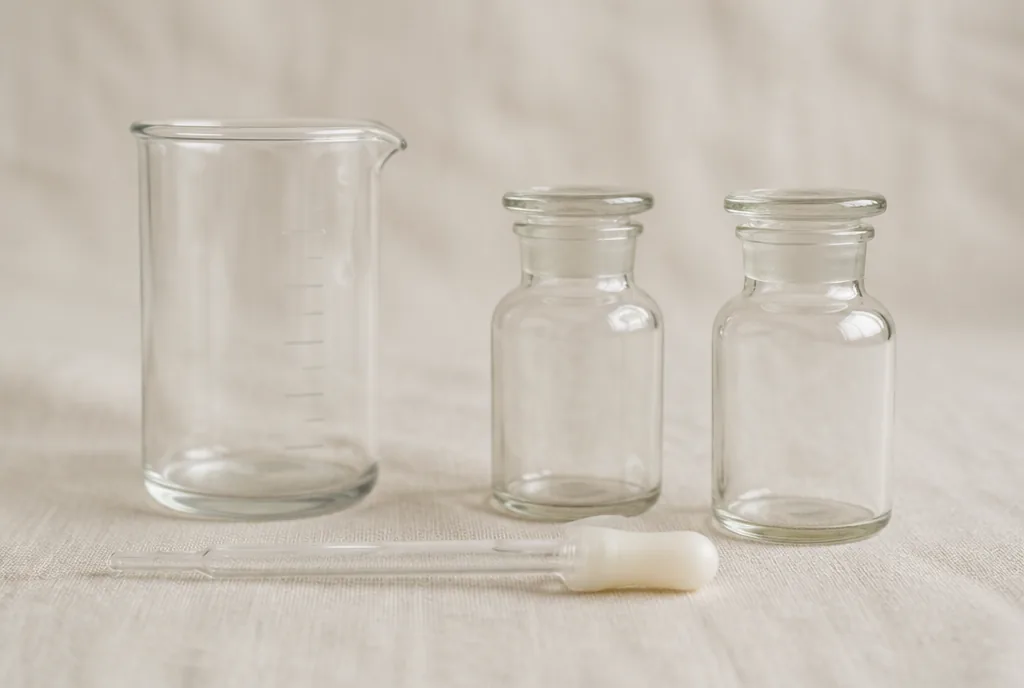
One bottle says 1,000 mg, another says 10 percent, a third says 300 mg per 10 ml. Three notations for the same quantity, and none of them compares directly with the others. The result is that the same batch produces a different figure depending on which retailer you asked, and nobody is quite sure what ended up in the final bottle. CBD dosage calculation nonetheless reduces to a single division.
The formula: milligrams divided by the total volume
CBD dosage calculation in a vapeable preparation rests on one operation: the quantity of cannabidiol in milligrams, divided by the total volume of the blend in millilitres.
A 1,000 mg shot poured entirely into 50 ml of e-liquid gives 60 ml of preparation. The final concentration is 1,000 divided by 60, so roughly 16.6 mg/ml.
The point almost everyone gets wrong is that the volume of the shot forms part of that total. Leaving it out overstates the real concentration by about 20 percent on a 60 ml bottle, which is enough to make two people mixing the same ingredients disagree about the answer.
The three notations that complicate a CBD dosage calculation
Before dividing anything, you have to know what the printed figure refers to. Manufacturers have never harmonised their practice, and the gap between two readings can reach a factor of three.
Milligrams per bottle is the most frequent notation on shots. A bottle stated at 2,000 mg contains 2,000 mg of cannabidiol in total, whatever its capacity. A 10 ml at 2,000 mg and a 30 ml at 2,000 mg therefore hold the same quantity but not the same concentration, and only the first figure enters the sum.
Milligrams per 10 ml is the second. Some brands quote a content brought back to 10 ml even on larger bottles, so a 50 ml bottle stated at 1,000 mg per 10 ml actually holds 5,000 mg. Always check whether the words per 10 ml sit next to the number. Without them, the value shown is that of the whole bottle.
The percentage is the third, and it converts directly: 1 percent equals 10 mg per millilitre. A preparation at 2 percent holds 20 mg/ml, and a 10 ml bottle at 10 percent holds 1,000 mg. This notation is rarer on vaping shots than on other formats, and it needs converting before any calculation.
Running the CBD dosage calculation backwards
In practice you rarely know the quantity available before you know what you need. The reverse operation is therefore the more useful one at mixing time.
Multiply the concentration you are aiming for in mg/ml by the final volume you want, and you obtain the quantity of cannabidiol required. Then divide that result by the content of one bottle to know how many to open.
For 60 ml at 10 mg/ml you need 600 mg. A 1,000 mg shot covers that comfortably: pour 6 ml of it and top up with 54 ml of base or nicotine free e-liquid.
That method avoids buying more than you need, since a strongly concentrated bottle divides without difficulty using a graduated syringe. It is also the only way to hit an unusual figure, because off the shelf packaging is built around whole bottles rather than around your target.
Reference figures by bottle size
These values assume a 10 ml shot poured whole into a nicotine free liquid, and they include the volume of the shot in the total. Any other case recalculates in one line.
- 500 mg shot into 40 ml of liquid, 50 ml total: 10 mg/ml
- 1,000 mg shot into 50 ml of liquid, 60 ml total: roughly 16.6 mg/ml
- 2,000 mg shot into 50 ml of liquid, 60 ml total: roughly 33.3 mg/ml
- 1,000 mg shot into 20 ml of liquid, 30 ml total: roughly 33.3 mg/ml
- 500 mg shot into 90 ml of liquid, 100 ml total: 5 mg/ml
The same final concentration can therefore be reached by several routes. Which one you pick depends on the volume you genuinely want to prepare, not on the number printed on the bottle you happen to own.
The handling error that wrecks the sum
The best conducted calculation is worthless if the pouring does not follow. An unsuitable order makes the result impossible to verify afterwards.
Never pour a shot into a bottle already filled to the brim: you would have to remove liquid, and the final volume becomes uncertain. Start from an empty graduated bottle, pour the shot first, then top up to the mark for your target volume.
That method has a second advantage. The level reached after each addition works as an intermediate check, so if the reading does not match the sum you expected, the error surfaces before the end rather than after.
Close the bottle and turn it over for about thirty seconds. A concentrated shot takes time to spread through a viscous liquid, particularly above 50 percent vegetable glycerine, and cannabidiol dissolves better in propylene glycol than in glycerine. Work with gloves, keep every bottle away from children and pets, and store the results out of direct light.
What the resulting figure does not tell you
A calculated concentration describes a concentration and nothing else. Three things escape the arithmetic entirely and deserve stating.
The legal frame comes first. Cannabidiol products sold in the United Kingdom are expected to qualify as exempt products, which means the container must hold no more than 1 mg of controlled cannabinoids. That threshold applies to the container rather than to the cannabidiol figure, which is why a bottle can advertise thousands of milligrams of CBD and remain within the rules.
The nicotine ceilings of 20 mg/ml and 10 ml bottles, along with the 2 ml tank limit, come from the Tobacco and Related Products Regulations 2016. They do not apply to a nicotine free preparation, though the age restriction on vaping products still does. Mixing rules for the other family are covered in our guide to the nicotine salt shot.
Solubility comes second, and it caps what very high glycerine ratios can realistically hold in suspension. The sum stays correct, but the blend may stay uneven, which is a good argument for checking the ratio of your base liquid before you commit.
Flavour comes third. The vegetal note of cannabidiol layers over the aroma and shows itself more as the concentration climbs, so the choice of CBD shot matters as much as the division itself. No effect of any kind can be attributed to these products, which hold no recognised indication.
Frequently asked questions
Do I need precision scales for this?
No, a graduated bottle and a 5 or 10 ml syringe are enough for everyday use. Scales become useful only for very fine recipes or for large volumes.
How do I recalculate after diluting a preparation?
The total quantity of cannabidiol does not change, only the volume increases. Divide the same number of milligrams by the new total volume.
Can I add two shots of different strengths?
Yes, add their milligrams together then divide by the total volume obtained. A 500 mg and a 1,000 mg poured into 40 ml give 1,500 mg across 60 ml, so 25 mg/ml.
Why do retailer tables show different figures from mine?
Most of them express a result in milligrams per bottle rather than milligrams per millilitre. Convert before comparing, otherwise the two values look incompatible.
Can a CBD oil replace a vaping shot?
No. Oils are not formulated to be heated in an atomiser and have nothing in common with a propylene glycol and glycerine base.
CBD dosage calculation: the division that settles everything
One operation, milligrams divided by total volume, covers every situation, provided you have converted the bottle’s notation first. It is that conversion, not the division, that produces the majority of errors.
Keep a written trace of every blend: volume, strength of the shot, concentration obtained. A CBD dosage calculation noted once replays in ten seconds the following time, and it makes any further checking unnecessary.
Editorial content for adult readers only. Vaping products usually contain nicotine, a substance that causes addiction. Not for sale to under-18s in the United Kingdom. This article is not a buying recommendation.
You might also like
Quick tips
CBD shot: mixing it right the first time
A CBD shot goes into a base or a nicotine free shortfill. The exact method, how to work out the final mg/ml, and when the blend refuses to settle.
01Morgane Trémaux · Lire l'astuce
Saving money
DIY e-liquid kit: what is really in the box?
What a DIY e-liquid kit actually contains, how to work out its cost per bottle, and the mistakes that spoil a first attempt at home mixing.
02Morgane Trémaux · Lire l'astuce
Small problems
Nicotine salt shot: dosage and how to use it
A nicotine salt shot is 20 mg/ml in 10 ml. Working out the final strength, the pouring order, and the mistakes that ruin a whole shortfill.
03Morgane Trémaux · Lire l'astuce